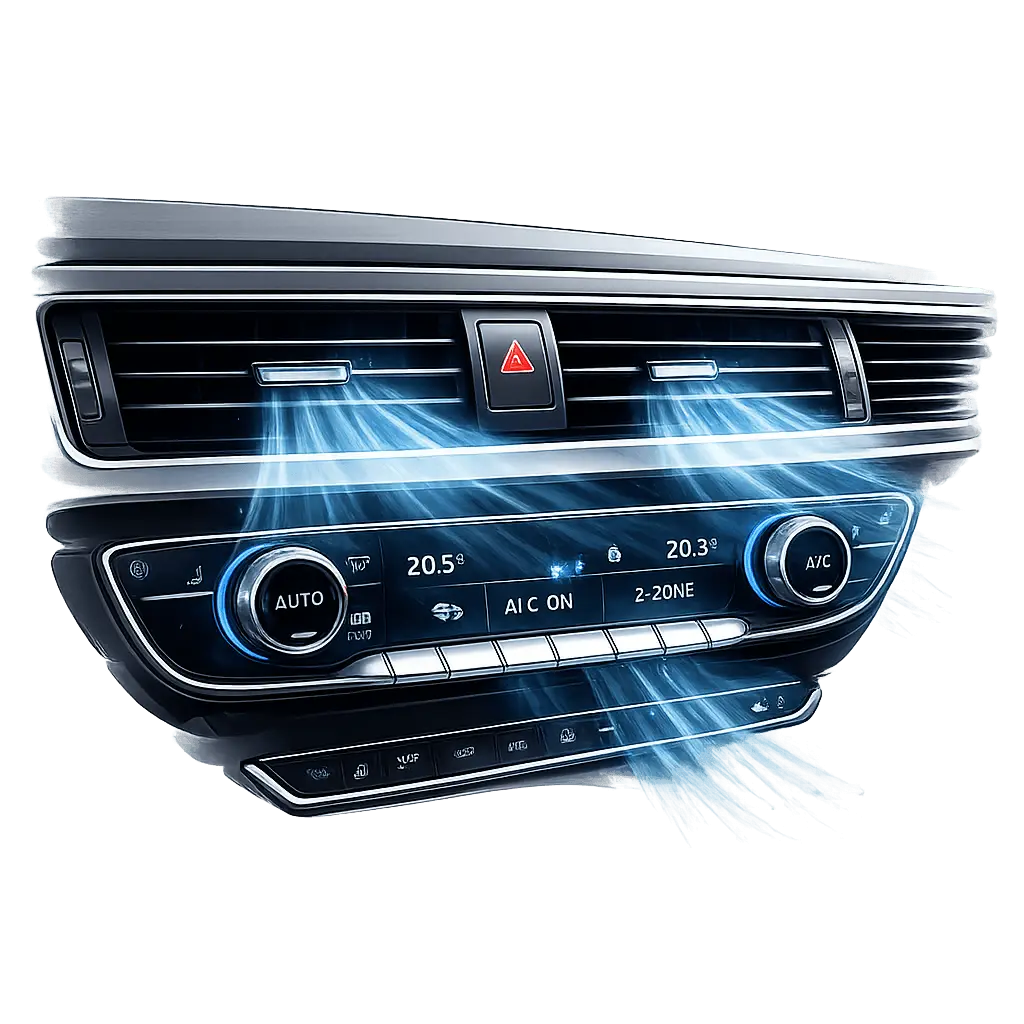
The Complete Guide to Car Air Conditioning Care in Extreme Climates
1. When Air Conditioning is a Vital Life-Support System
In most parts of the world, automotive air conditioning is classified as a comfort feature—a pleasant luxury used on particularly warm summer afternoons. In Dubai and the wider Gulf region, however, car AC is an absolute necessity. During the peak summer months, ambient temperatures routinely exceed 45°C (113°F) and can spike to over 50°C (122°F). When a vehicle sits parked under the direct UAE sun for just an hour, greenhouse heat absorption can cause cabin temperatures to soar to a dangerous 70°C to 80°C. Stepping into such a cabin is not only highly uncomfortable; it poses immediate risks of heat exhaustion and heatstroke.
Operating a motor vehicle under these extreme thermal conditions puts immense strain on both the driver and the machine. Heat impairs cognitive function, delays reaction times, and increases driver fatigue, directly translating to a higher risk of road accidents. For the vehicle, the air conditioning system must work at maximum capacity to pull heat out of the cabin and dissipate it. This places an immense mechanical load on the engine, the cooling fan, and the electrical system. A minor defect in your car's AC—such as a small leak or a worn belt—will rapidly lead to total system failure under the load of Dubai's summer heat.
Maintaining your car's AC is not simply about refilling refrigerant when it stops blowing cold. It requires a comprehensive approach to system hygiene, mechanical inspection, and component care. An air conditioner is a closed thermodynamic loop; if it fails to cool, there is always an underlying mechanical or chemical reason. Our specialized service center is dedicated to ensuring that your car's climate control system operates at peak efficiency, keeping your cabin comfortable and your drive safe, even in the harshest desert conditions.
2. The Science of Cold: How Your Car's AC Works
To understand why AC repairs are highly technical, it helps to understand the thermodynamic cycle of automotive refrigeration. A common misconception is that air conditioners "generate" cold. In reality, they work by absorbing heat from the cabin and rejecting it into the outside air. This is achieved by manipulating the physical states of a chemical refrigerant (typically R134a or the newer eco-friendly R1234yf) between liquid and gas states. Here are the five key components that make this cycle possible:
1. The AC Compressor
Commonly referred to as the heart of the AC system, the compressor is driven by the engine's accessory belt. Its role is to take low-pressure gaseous refrigerant from the cabin and compress it into a high-pressure, high-temperature gas. This compression is crucial because it raises the temperature of the refrigerant to a level higher than the ambient outside air, allowing it to reject heat later in the cycle.
2. The Condenser
Mounted directly in front of the vehicle's engine radiator, the condenser looks like a smaller radiator. As the hot, pressurized gas flows through the condenser's tubes, outside air (pulled in by the cooling fans or vehicle motion) passes over the cooling fins. This air absorbs heat from the refrigerant, causing it to cool and condense into a high-pressure liquid.
3. The Receiver-Drier or Accumulator
This canister acts as a filtration and storage unit. It contains a chemical desiccant that absorbs moisture from the liquid refrigerant. Removing moisture is critical: any water inside the AC system will react with the refrigerant oil to form acids, which will corrode internal components and can freeze inside the expansion valve, blocking flow.
4. The Expansion Valve or Orifice Tube
This is the restriction point. The high-pressure liquid refrigerant is forced through a tiny nozzle into a low-pressure chamber. As the pressure drops suddenly, the refrigerant rapidly cools and atomizes, turning into a cold, low-pressure mist. This is the exact principle that causes an aerosol spray can to feel cold when sprayed.
5. The Evaporator Core
Located deep inside the dashboard, the evaporator is the final step. Blower fan motor blows warm cabin air over the cold fins of the evaporator. The refrigerant inside the evaporator absorbs the heat from this cabin air. As it absorbs heat, the liquid refrigerant boils and turns back into a low-pressure gas, which then returns to the compressor to start the cycle again. The moisture in the warm cabin air condenses on the cold evaporator fins and drains under the car (which is why you see puddles of water under parked cars with active AC).
3. Critical Symptoms of a Failing Air Conditioning System
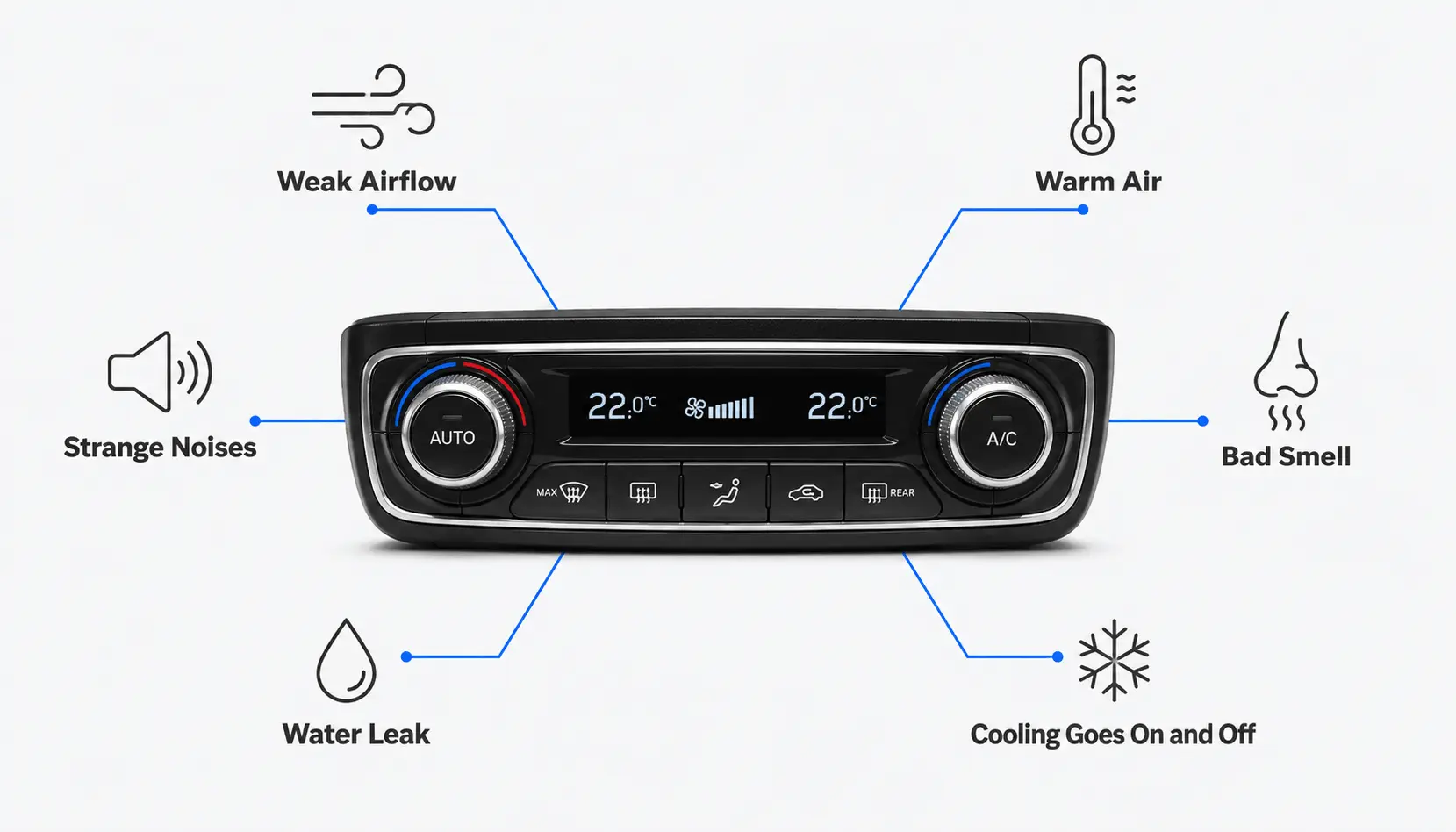
Air conditioning issues usually present visual, physical, or olfactory warning signs before the system stops cooling entirely. Identifying these signs early can save you from replacing expensive components like the compressor.
- Blowing Warm Air or Lukewarm Air
This is the most common symptom. If the vents are blowing air that is the same temperature as the cabin (or warmer), it indicates a lack of refrigerant (refrigerant leak), a failed compressor clutch that is not engaging, or a blocked condenser that cannot dissipate heat.
- Intermittent Cooling (Cold Then Warm)
If your AC blows freezing cold when you start driving, but suddenly turns warm after 10-15 minutes, the system is likely freezing up due to moisture in the refrigerant or a failing expansion valve. Alternatively, the compressor clutch may be slipping as it gets hot, disconnecting the pump.
- Metallic Rattling or Whining Noises
If turning on the AC results in a loud rattle, click, or whine from the engine bay, the internal bearings of the AC compressor are failing, or the compressor clutch pulley is worn out. Operating a noisy compressor can lead to internal seizure, throwing metal debris through the system.
- Musty, Vinegar, or Foul Odors
A foul smell when you turn on the AC points to mold, mildew, or bacterial growth on the surface of the evaporator core. Because the evaporator is dark and damp, it is a breeding ground for pathogens. A dirty cabin air filter also traps dust and moisture, creating smells.
- Water Leaking Into Passenger Footwell
If you notice the carpet in your front passenger footwell is wet, the evaporator drain tube is clogged with dust and dirt. Instead of draining outside, the condensed water backs up inside the HVAC housing and spills into your cabin, which can ruin electrical control units.
4. Our Master Diagnostic and Gas Recharge Protocol
Car AC service requires specific tools to prevent venting chemicals into the atmosphere and to isolate microscopic leaks. We adhere to a rigid multi-step protocol:
Phase 1: Pressure Profiling
We connect an AC manifold gauge set to the system's high-pressure and low-pressure ports. By analyzing the relationship between high and low-side pressures while the compressor is running, we can tell if the compressor is pumping correctly, if there is a block in the expansion valve, or if the system is simply low on charge.
Phase 2: Leak Detection (UV Dye & Electronic Sniffers)
Since refrigerant is a gas, finding a leak visually is difficult. We inject a fluorescent UV dye into the system along with a small charge, run the AC, and trace the lines with a UV light to find glowing dye leaks. We also use electronic halogen leak detectors (sniffers) that detect chemical gases down to parts per million near the hard-to-reach evaporator core.
Phase 3: Vacuum Hold Test & Chemical Recharge
Before refilling the gas, we connect a heavy-duty vacuum pump to the system. We evacuate all remaining air and moisture, pulling a vacuum of 30 inches of mercury (inHg). We hold this vacuum for 15-20 minutes. If the vacuum drops, a leak is present. Once confirmed sealed, we weigh in the precise amount of genuine refrigerant (in grams) as specified by the manufacturer, along with fresh PAG lubricant oil.
5. The True Economics: The Roadside Gas Trap
In Dubai, many roadside shops offer cheap "AC top-ups." This is a classic trap that will cost you more in the long run. First, air conditioning is a closed, hermetically sealed loop. It does not "consume" gas over time. If your AC is low on refrigerant, there is a leak in the system. Topping it up without finding and fixing the leak means the new gas will leak out again, sometimes within days.
Second, roadside shops often use low-grade, generic refrigerant containing moisture or chemical impurities. They also skip adding compressor oil. Over time, running a compressor without oil or with moisture in the system leads to internal scoring, metal shedding, and eventual compressor seizure (known as "black death"). When a compressor seizes, it sends metal shavings throughout the entire AC system, requiring you to replace the compressor, condenser, expansion valve, and lines, resulting in a massive repair bill.
6. Dubai Survival Guide: Cabin Filters & Evaporator Sanitation
The hot, dusty, and sandy climate of the UAE accelerates wear on AC systems. To protect your system:
Frequent Cabin Air Filter Replacements
The cabin filter catches sand dust and pollen before it enters your ventilation. In Dubai, this filter gets clogged rapidly. A clogged filter restricts airflow, forcing the blower motor to work harder, and allows dust to deposit on the wet evaporator fins, forming a layer of mud that blocks heat transfer.
Evaporator Core Cleaning
If your car AC smells musty upon startup, bacteria has built up in the evaporator. We perform specialized foam cleaning services, spraying an antibacterial sanitizing foam directly onto the evaporator core to dissolve mold and mud, restoring clean, healthy air to your cabin.
7. Frequently Asked Questions (FAQs)
What is the difference between R134a and R1234yf AC gas?
R134a is the standard refrigerant used in vehicles manufactured before 2017. R1234yf is a newer, environmentally friendly gas with a much lower global warming potential, used in almost all modern cars. The two systems are completely incompatible and require different diagnostic machines, valves, and oils. We support both systems.
How long does a typical AC gas refill take?
A professional recovery, vacuum hold test, and recharge process takes approximately 45 to 60 minutes. If a leak is detected during the vacuum hold test, repair times will vary depending on which component is leaking.
Why does my AC blow cold only when the car is moving?
This is usually caused by insufficient airflow over the AC condenser. When the car is moving, air is forced through the condenser. When stopped, the condenser relies on electric cooling fans. If the fan is failing, or if the condenser is clogged with sand and debris, the AC will blow warm at stoplights.
Is it safe to drive my car if the AC compressor is noisy?
It is risky. If the noise is due to failing internal bearings, the compressor could seize. When the compressor seizes, it can snap the engine's accessory serpentine belt. Since the belt drives the water pump and alternator, a snapped belt will cause the engine to overheat immediately, leaving you stranded.
Can you repair a leaking AC hose, or does it have to be replaced?
AC hoses operate under high pressure (up to 350 PSI on the high side). Repairing or patching rubber hoses is not reliable. We replace leaking rubber hoses or aluminum lines with OEM parts. If the part is obsolete, we can custom-crimp new barrier hoses onto the original metal fittings.
What is an AC system flush?
An AC flush involves disconnecting the system and pumping a specialized chemical solvent through the lines, condenser, and evaporator to remove sludge, burnt compressor oil, and metallic debris. This is mandatory when replacing a seized compressor to protect the new unit.
8. The Final Word: Stay Cool with Professional AC Care
Don't let a failing air conditioner turn your daily drive into a grueling experience. At our service center, we treat your car's AC with the specialized care it deserves. We invest in the latest automated refrigerant recovery and recharge stations, ensuring precise gas weights and zero chemical venting. Our technicians are fully trained in electronic troubleshooting, sensor diagnostics, and heavy mechanical repairs for evaporators and compressors. We provide honest diagnostics, upfront pricing, and photographic proof of any leak areas we locate. Protect your comfort and safety. Contact us today to schedule a comprehensive AC system diagnostic.