logo
Engine Repair Dubai

Expert Car Engine Repair in Dubai

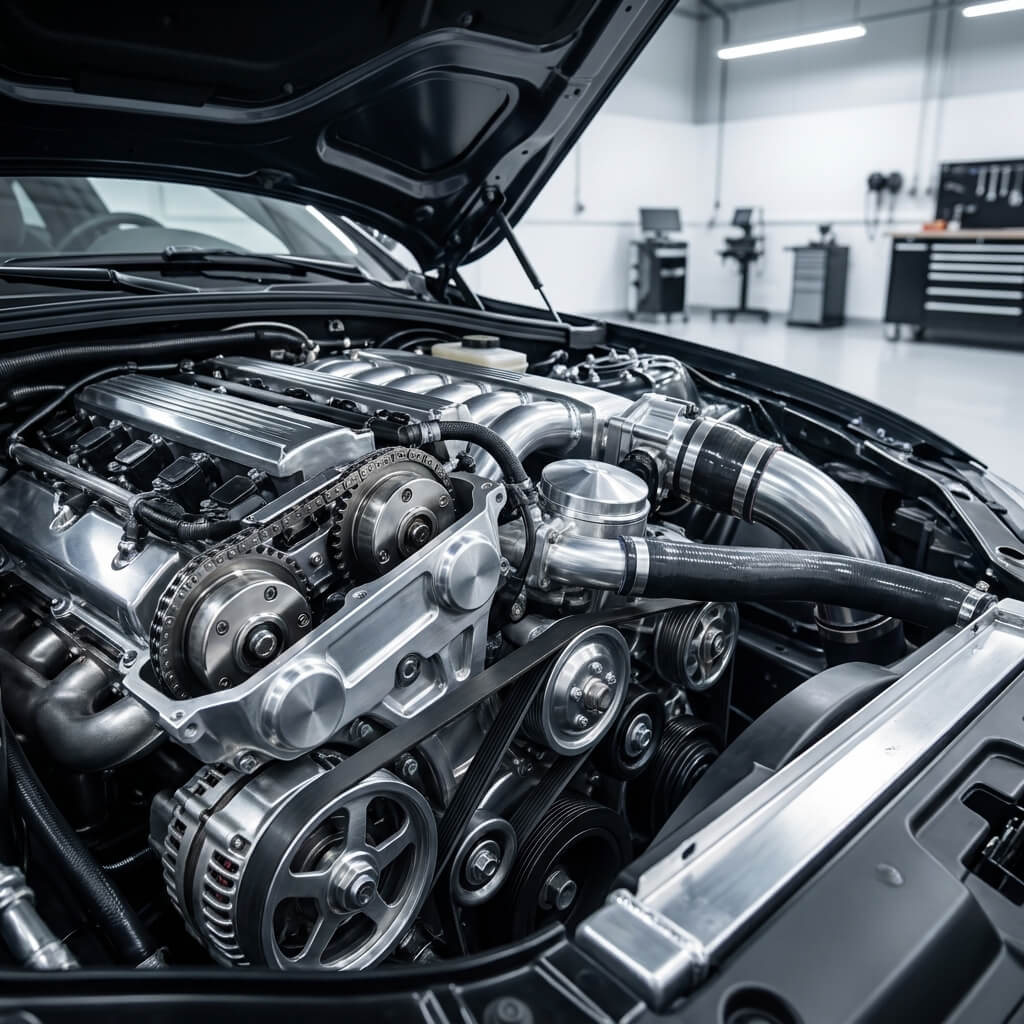
The engine is the beating heart of your vehicle. In the extreme climate of the UAE, ensuring its optimal performance is not just a luxury—it is an absolute necessity. Our certified specialists provide unparalleled engine diagnostics, routine maintenance, complex repairs, and complete engine rebuilds using state-of-the-art technology and genuine OEM parts.

Request a Free Diagnostic Quote

Comprehensive Guide to Engine Repair & Maintenance

1. The Importance of Your Car's Engine

The internal combustion engine is a marvel of modern engineering, comprising hundreds of moving parts working in perfect synchronization under extreme temperatures and immense pressure. Whether you drive a compact city car, a rugged SUV, or a high-performance sports car, the engine is unequivocally the most critical and complex component of your vehicle. It is responsible for converting fuel into the mechanical energy that propels you forward. Without a properly functioning engine, your vehicle is rendered immobile.

In Dubai and the wider United Arab Emirates, engines are subjected to some of the harshest driving conditions on the planet. Ambient temperatures routinely soar above 45°C (113°F) during the long summer months, while airborne sand and fine dust particles pose a constant threat to internal components. These extreme environmental factors place an enormous strain on the engine's cooling system, lubrication system, and air filtration system. Consequently, the rate of wear and tear on engine components in this region is significantly higher than in more temperate climates.

Ignoring minor engine irregularities can rapidly cascade into catastrophic mechanical failures. A slight hesitation during acceleration, a subtle knocking sound, or a minor drop in fuel efficiency might seem inconsequential at first glance, but these are often the early warning signs of underlying issues that, if left unaddressed, will result in exorbitant repair bills or the need for a complete engine replacement. Our mission is to provide you with an exhaustive, transparent, and highly professional engine repair service that not only fixes the immediate problem but also extends the operational lifespan of your vehicle. We believe in proactive maintenance rather than reactive repair.

2. A Technical Deep Dive: How Your Engine Works

To truly understand the value of professional engine repair, it is beneficial to possess a fundamental grasp of how the internal combustion engine operates. Most modern vehicles utilize a four-stroke engine cycle, famously known as the Otto cycle. The four strokes are: Intake, Compression, Power, and Exhaust.

  • The Intake Stroke: The piston moves downward within the cylinder, creating a vacuum. The intake valve opens, drawing a precise mixture of air and atomized fuel into the combustion chamber. In direct-injection engines, only air is drawn in, and fuel is injected directly into the cylinder under extremely high pressure.
  • The Compression Stroke: The intake valve closes, sealing the cylinder. The piston moves upward, compressing the air-fuel mixture into a highly volatile, highly pressurized state. This compression significantly increases the temperature of the mixture and maximizes the potential energy of the subsequent explosion.
  • The Power Stroke: Just before the piston reaches the top of its stroke (Top Dead Center), the spark plug ignites the compressed mixture (in gasoline engines). The resulting explosion forces the piston downward with immense kinetic energy. This downward force turns the crankshaft, which ultimately delivers power to the transmission and the wheels. In diesel engines, the heat of compression alone ignites the fuel, eliminating the need for spark plugs.
  • The Exhaust Stroke: The piston reaches the bottom of its stroke and begins to rise again. The exhaust valve opens, allowing the burnt gases to be pushed out of the cylinder and into the exhaust system, making way for the next intake stroke.

This cycle repeats thousands of times per minute (RPM). For this symphony of mechanical motion to occur without catastrophic self-destruction, the timing must be immaculate. The camshaft(s) must open and close the valves at the exact right millisecond relative to the position of the pistons, a synchronization maintained by the timing belt or timing chain. Furthermore, a constant film of high-quality engine oil must separate the moving metal parts to minimize friction and dissipate heat. A failure in the timing system, a loss of oil pressure, or a failure in the cooling system will rapidly lead to severe internal engine damage, such as bent valves, scored cylinder walls, or a seized crankshaft.

3. Critical Warning Signs Your Engine Requires Immediate Attention

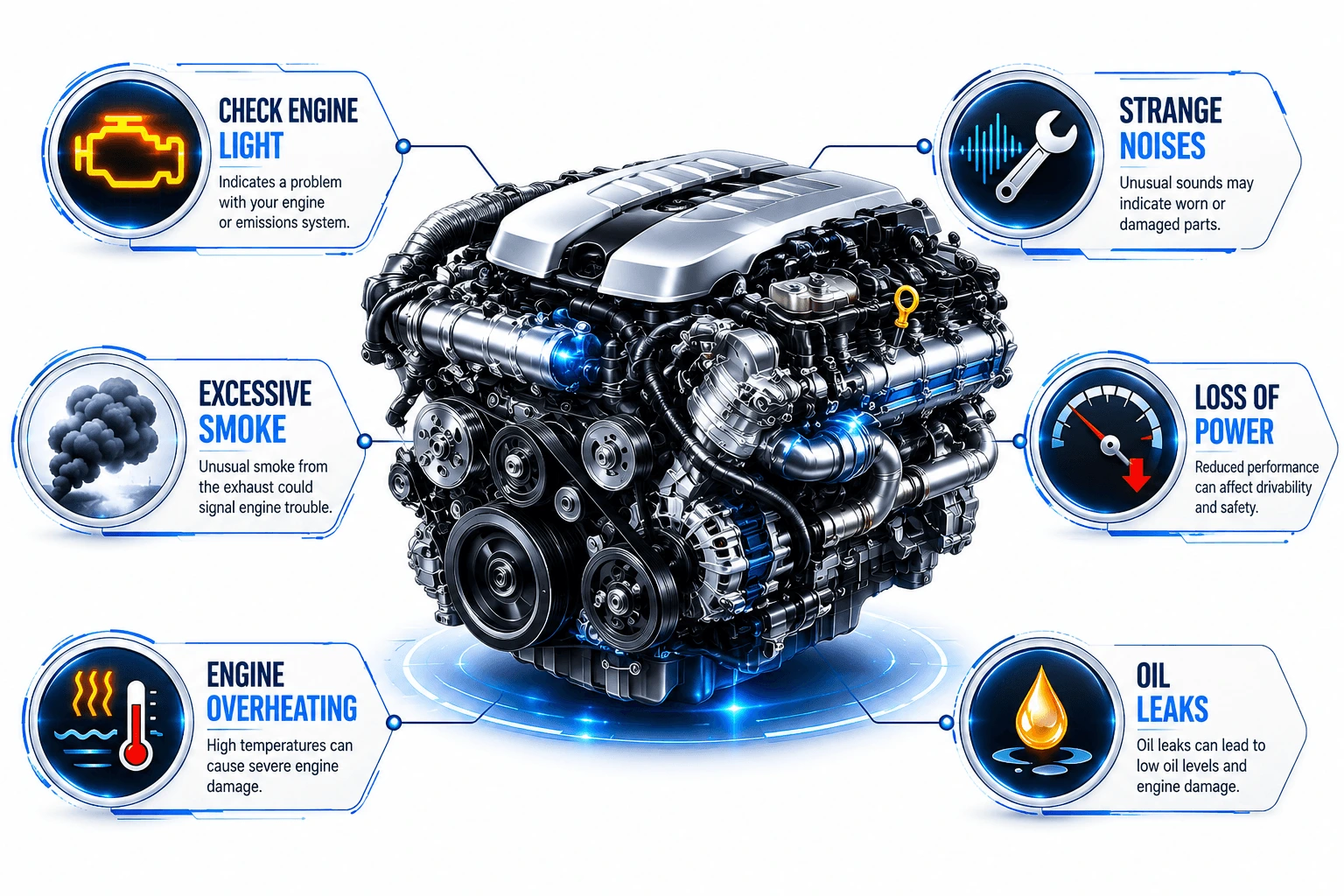
Modern vehicles are equipped with sophisticated On-Board Diagnostics (OBD-II) systems continuously monitoring hundreds of sensors. However, the driver remains the most critical diagnostic tool. Being attuned to the specific sights, sounds, smells, and sensations of your vehicle can save you thousands of dirhams. Here is an exhaustive breakdown of the warning signs you must never ignore:

A. The "Check Engine" Light (MIL)

The Malfunction Indicator Lamp, commonly known as the Check Engine light, is the most obvious warning. It can indicate a minor issue, such as a loose gas cap causing an evaporative emissions leak, or a major issue, such as a severe engine misfire that is dumping raw fuel into the catalytic converter. If the light is solid, you should schedule a diagnostic appointment promptly. If the light is flashing, this indicates a critical, active misfire that is causing immediate damage to the catalytic converter. You must pull over safely and have the vehicle towed to our service center.

B. Abnormal Engine Noises

Engines are inherently noisy, but you should be familiar with the baseline hum of your vehicle. Any deviation from this baseline is a symptom of mechanical distress.

  • Knocking or Pinging: Often referred to as "detonation" or "pre-ignition," this sounds like marbles rattling inside the engine block. It occurs when the air-fuel mixture ignites prematurely, colliding with the rising piston. This can destroy pistons and bend connecting rods. It is often caused by using low-octane fuel, incorrect spark plug heat ranges, or a lean air-fuel mixture.
  • Deep Tapping or Ticking: A rhythmic ticking noise that increases with engine RPM is frequently associated with the valvetrain. It could indicate low oil pressure, insufficient oil volume, worn camshaft lobes, or failing hydraulic lifters. If the oil cannot reach the top of the engine to lubricate the valves, severe damage will ensue.
  • Deep, Heavy Knocking (Rod Knock): This is the sound every mechanic dreads. A deep, heavy knock coming from the lower section of the engine block usually indicates a failed connecting rod bearing. The protective film of oil has broken down, and metal is violently impacting metal. The engine must be shut off immediately; it requires a complete rebuild or replacement.
  • Squealing or Chirping: A high-pitched squeal upon startup or acceleration is almost always indicative of a worn, loose, or glazed serpentine belt. While the belt itself is inexpensive, a snapped belt will disable the alternator, water pump, and power steering, leaving you stranded.
  • Hissing: A hissing sound while the engine is running points toward a vacuum leak or a leak in the cooling system. A vacuum leak allows unmetered air into the engine, causing a lean condition, rough idling, and poor performance.

C. Exhaust Smoke Colors and Their Meanings

The color of the smoke exiting your tailpipe provides a visual diagnostic of what is burning inside the combustion chamber alongside the fuel.

  • Blue or Gray Smoke: This is a clear indicator that the engine is burning oil. The oil is bypassing the piston rings, leaking past the valve stem seals, or being drawn through a faulty PCV (Positive Crankcase Ventilation) valve. Continued operation will foul the spark plugs, destroy the catalytic converter, and eventually lead to oil starvation and catastrophic engine failure.
  • Thick White Smoke: While a small amount of white vapor is normal upon cold startup due to condensation, thick, billowing white smoke that persists is a major red flag. It signifies that coolant (water and antifreeze) is entering the combustion chamber and vaporizing. This is almost exclusively caused by a blown head gasket, a cracked cylinder head, or a cracked engine block. If you see thick white smoke, shut the engine off immediately to prevent hydro-locking and total destruction.
  • Black Smoke: Black smoke indicates that the engine is running "rich"—it is burning too much fuel and not enough air. This can be caused by a leaking fuel injector, a faulty oxygen (O2) sensor, a defective mass airflow (MAF) sensor, or a clogged engine air filter. Running rich dramatically reduces fuel economy and will rapidly clog and ruin the catalytic converter.

D. Performance Issues and Sensations

Pay attention to how the vehicle feels during operation. A sudden loss of power, hesitation during acceleration, or stalling at stoplights indicates an imbalance in the air, fuel, or spark delivery systems. A rough, vibrating idle often points to a misfiring cylinder, worn engine mounts, or a severe vacuum leak. Furthermore, an unexplained and dramatic drop in fuel efficiency is a subtle but definitive sign that the engine management system is compensating for a failing component.

4. Our State-of-the-Art Diagnostic Protocol

Guesswork has no place in modern automotive repair. The complexity of today's computerized engines demands a rigorous, scientific approach to diagnostics. When you bring your vehicle to our service center with an engine complaint, we initiate a comprehensive, multi-step diagnostic protocol to ensure absolute accuracy.

Step 1: The Initial Consultation and Road Test

We begin by extensively interviewing you, the owner. Nobody knows the vehicle's quirks better than the person who drives it daily. We ask specific questions about when the symptom occurs (hot or cold, accelerating or braking, high speeds or low speeds). If the vehicle is safe to drive, our master technician will perform a road test to replicate the condition and observe the engine's behavior firsthand under load.

Step 2: Computerized OBD-II Scanning and Live Data Analysis

We connect a professional-grade, bi-directional diagnostic scanner to the vehicle's OBD-II port. We retrieve not only the active Diagnostic Trouble Codes (DTCs) but also the pending codes and the "freeze frame" data—a snapshot of the exact engine parameters (RPM, coolant temperature, vehicle speed, fuel trim) at the exact millisecond the fault occurred. More importantly, we analyze the live data streams from the engine's sensors in real-time, looking for anomalies that haven't yet triggered a code.

Step 3: Mechanical Testing and Visual Inspection

Electronic data only tells half the story. We must verify the mechanical integrity of the engine. Depending on the symptoms, this may involve performing a compression test to check the health of the piston rings and valves, a cylinder leak-down test to pinpoint the exact location of compression loss, or attaching a mechanical gauge to verify actual oil pressure versus what the sensor is reporting. We also perform a meticulous visual inspection using borescopes to examine the internal condition of the cylinders and valves without dismantling the engine.

Step 4: Formulating the Repair Strategy

Once the root cause is definitively identified, we formulate a targeted repair strategy. We do not engage in "parts swapping" hoping to accidentally fix the issue. We provide you with a detailed, transparent, itemized quotation that explains exactly what failed, why it failed, what parts are required for the repair, and the exact labor cost. We proceed with the repair only upon your explicit authorization.

5. The Spectrum of Engine Repairs We Execute

Our facility is equipped and staffed to handle the entire spectrum of engine-related issues, from minor peripheral component replacements to complete, bare-block engine rebuilds. Here is an overview of the services we expertly provide:

Top-End Repairs (Cylinder Head)

The top end of the engine houses the valvetrain, which controls the breathing of the engine. Issues here are common and critical.

  • Head Gasket Replacement: The head gasket is a critical seal between the cylinder head and the engine block. When it fails due to severe overheating, coolant mixes with oil, creating a milky sludge that destroys bearings, and combustion gases pressurize the cooling system. Replacing a head gasket requires extensive dismantling, precise cleaning, and checking the cylinder head for warpage (resurfacing it if necessary) before reassembly with new torque-to-yield bolts.
  • Valve Job / Valve Stem Seals: If valves are burnt, bent, or if the seals are leaking oil into the combustion chamber, we remove the cylinder head, re-machine the valve seats, install new valves and seals, and ensure a perfect, airtight seal.
  • Timing Chain / Timing Belt Replacement: The timing component keeps the camshaft and crankshaft in perfect sync. A snapped timing belt on an "interference" engine will result in the pistons smashing into the open valves, causing catastrophic damage. We replace timing belts and chains proactively according to manufacturer intervals, along with the associated tensioners, guides, and water pumps.

Bottom-End Repairs (Engine Block)

The bottom end contains the heavy-duty components that convert combustion into rotational force: the pistons, connecting rods, and crankshaft.

  • Piston Ring Replacement: Worn piston rings lead to low compression, loss of power, and excessive oil consumption (blow-by). We re-hone the cylinder walls and install new, precisely gapped piston rings to restore factory compression.
  • Main and Rod Bearings: If oil starvation has occurred, the bearings that the crankshaft spins on will be destroyed, resulting in "rod knock." We drop the oil pan, inspect the crankshaft journals for scoring, and replace the bearings to precise clearances using Plastigauge.

Complete Engine Rebuilds and Swaps

When an engine has suffered catastrophic failure—such as a thrown rod that has punched a hole in the block, or severe overheating that has melted pistons—a complete overhaul is required. We remove the engine from the vehicle, completely disassemble it down to the bare block, send the block and head to a machine shop for cleaning, boring, and decking, and then reassemble the engine using entirely new internal components (pistons, rings, bearings, oil pump, gaskets). The result is a "zero-mile" engine that will perform like new. Alternatively, if a rebuild is not economically viable, we source and install high-quality, low-mileage used or remanufactured engines, providing a cost-effective solution to get you back on the road.

6. The Economics of Engine Repair: Understanding the Costs

Engine repair is inherently expensive. It is the most complex assembly in the vehicle, requiring highly specialized tools, vast technical knowledge, and dozens of hours of labor to dismantle and reassemble. However, a properly executed engine repair or rebuild is almost always significantly cheaper than purchasing a new vehicle, especially considering the depreciation hit taken when buying a new car.

When reviewing a quote for engine work, it is vital to understand the breakdown. A significant portion of the cost is labor. Removing a cylinder head on a modern V6 or V8 engine packed tightly into a small engine bay can take 10-15 hours of labor alone. The cost of parts is also substantial. We refuse to compromise on quality; we use OEM (Original Equipment Manufacturer) or premium tier-one aftermarket parts. Using cheap, inferior head gaskets or timing components to save a few dirhams upfront inevitably leads to premature failure and having to pay for the massive labor cost all over again. Our quotes reflect doing the job correctly the first time, ensuring reliability and peace of mind.

7. Preventative Maintenance: The Dubai Survival Guide

The old adage, "an ounce of prevention is worth a pound of cure," is nowhere more accurate than in the realm of automotive engines operating in the UAE. The extreme ambient heat and airborne dust create a uniquely hostile environment. Here is our definitive guide to keeping your engine alive in Dubai:

Religious Oil Changes

Engine oil is the lifeblood of the vehicle. In Dubai's heat, oil degrades, oxidizes, and loses its viscosity much faster than in cooler climates. We strongly advise against following the standard 15,000km "long-life" intervals suggested by some European manufacturers. For optimal longevity in the UAE, change high-quality, fully synthetic engine oil and the filter every 7,000 to 10,000 kilometers, or every 6 months. Clean oil reduces friction, carries away heat, and suspends harmful contaminants.

Cooling System Vigilance

The cooling system is your engine's only defense against the searing desert heat. A single severe overheating event can warp the cylinder head and destroy the engine. Check coolant levels weekly. Have the cooling system pressure tested annually to find micro-leaks in hoses or the radiator. Flush and replace the engine coolant every 40,000 to 60,000 kilometers, as the anti-corrosion additives break down over time, leading to internal rust and water pump failure.

Air Filtration is Critical

The air in the UAE is laden with fine silica sand dust. If this dust bypasses the air filter and enters the combustion chamber, it acts like liquid sandpaper, scoring the cylinder walls and destroying the piston rings in short order. Inspect the engine air filter at every oil change and replace it frequently. Never use cheap, unbranded air filters; they allow microscopic particles to pass through.

Do Not Ignore Fluid Leaks

If you notice a puddle of fluid under your parked car, investigate it immediately. Dark brown or black fluid is engine oil. Pink, green, or orange fluid is coolant. Red or brown fluid is transmission or power steering fluid. A minor oil leak from a valve cover gasket is a cheap fix; ignoring it until the engine runs dry of oil will cost you a new engine.

8. Frequently Asked Questions About Engine Repair

How long does a complete engine rebuild take?

A complete engine rebuild is a meticulous process. Depending on the availability of parts and the complexity of the engine (e.g., a simple inline-4 vs. a complex twin-turbo V8), the process typically takes between 7 to 14 working days. This includes removal, machining, reassembly, installation, and rigorous testing.

Is it better to rebuild an engine or buy a used one?

This depends on the situation. A rebuilt engine, done correctly with new internal parts, is essentially a brand-new engine and offers the highest reliability. A used engine is cheaper and faster to install, but its internal condition and history are often unknown, presenting a higher risk. We will provide quotes for both options and advise you based on your budget and how long you plan to keep the car.

Why is my car consuming so much oil?

High oil consumption is usually caused by worn piston rings (allowing oil into the combustion chamber), worn valve stem seals, a malfunctioning PCV valve, or external leaks (e.g., leaking oil pan gasket or rear main seal). A diagnostic test is required to determine the exact cause.

Can I drive my car if it is overheating?

Absolutely not. If the temperature gauge goes into the red zone, or if you see a warning message to pull over, you must stop the vehicle immediately in a safe location and turn off the engine. Driving even one additional kilometer while severely overheating will warp the cylinder head and destroy the engine.

What causes a timing belt to break, and what happens when it does?

Timing belts break due to age, mileage, oil contamination, or failure of the tensioner pulley. They do not give a warning before they snap. If it snaps while the engine is running in an 'interference' engine, the pistons will collide with the valves, bending the valves and requiring a very expensive cylinder head rebuild. This is why preventative replacement based on mileage is mandatory.

Do you offer a warranty on engine rebuilds?

Yes, we stand firmly behind our work. We offer comprehensive warranties on all major engine repairs and full rebuilds, covering both the parts and our labor. The exact duration of the warranty depends on the specific repair performed.

9. The Final Word: Why Trust Us With Your Engine

Entrusting your vehicle to a mechanic for major engine work is a significant decision involving substantial financial investment. At our facility, we differentiate ourselves through absolute transparency, rigorous technical competence, and an unwavering commitment to quality. We do not take shortcuts. We do not use substandard parts. Our certified master technicians undergo continuous training to stay abreast of the latest automotive technologies. When you bring your vehicle to us, you are not just getting a repair; you are gaining a dedicated automotive partner committed to keeping your engine running flawlessly in the demanding environment of the UAE. Contact us today for a comprehensive diagnostic assessment and experience the difference of true professional engine care.

What our Customers Say about us

EXCELLENT

Based on 9 reviews

K

Khalid Al Mazrouei

2 weeks ago

My car battery was completely dead and wouldn't hold a charge. The technician diagnosed the issue quickly and replaced it with a quality battery. The repair was done at my office parking - super convenient!

N

Nadia Ahmed

3 weeks ago

Excellent battery repair service! They tested my battery, found it was just corroded terminals, cleaned everything up and saved me from buying a new one. Honest and professional service.

R

Rajesh Kumar

1 month ago

Called them at 7 AM when my battery died. The technician arrived within 30 minutes, diagnosed the alternator issue, and got my car running. Fast, reliable, and reasonably priced!