The Definitive Guide to Vehicle Steering & Suspension Systems
1. The Critical Balance of Comfort, Handling, and Safety
When we think of car maintenance, engine tune-ups and oil changes are typically the first tasks that come to mind. However, the suspension system is equally vital, serving as the unsung hero of your vehicle's overall performance. Operating silently beneath the chassis, the steering and suspension systems serve a dual role that is fundamental to your driving experience. First, they provide ride comfort by isolating you and your passengers from the harsh vibrations, bumps, and imperfections of the road surface. Second, and far more importantly, they ensure driving safety by keeping all four tyres firmly planted on the tarmac, enabling reliable steering, acceleration, and braking control.
Without a properly functioning suspension system, your vehicle is highly unstable and dangerous. An vehicle's suspension must absorb massive kinetic forces. Every bump, pothole, speed breaker, and expansion joint on the highway sends shockwaves through the wheels. If these forces are not properly dampened, they will compromise tyre-to-road contact. When a tyre loses contact with the ground, even for a fraction of a second, your ability to steer or brake is instantly lost. Thus, suspension health directly correlates to your vehicle's braking distance, cornering stability, and general roadholding safety.
In Dubai and the wider UAE, where multi-lane highways like Sheikh Zayed Road accommodate high-speed traffic alongside stop-and-go urban commutes, suspension integrity is paramount. Swerving to avoid debris at 120 km/h requires immaculate steering response and body roll control. A worn-out shock absorber or a loose control arm bushing can make the difference between a safe evasive maneuver and a complete loss of control. Understanding how this system works, recognizing the warning signs of failure, and executing timely repairs is key to protecting your automotive investment and, more importantly, the lives of you and your family.
2. Technical Anatomy: Inside the Suspension & Alignment System
A car's suspension is not a single component, but a complex, interconnected network of linkages, damping devices, joints, and rubber buffers. Here is a breakdown of the primary mechanical elements that dictate how your car handles:
Shock Absorbers & Struts
Although often used interchangeably, shocks and struts are distinct. A shock absorber is a hydraulic damping device that sits parallel to the spring, designed solely to control the oscillation (bouncing) of the spring. It works by forcing hydraulic fluid through tiny orifices inside a piston, converting kinetic energy into heat. A strut, however, is a structural component of the suspension. It houses the coil spring and the damper as a single assembly, acting as a pivot point for the steering and supporting the physical weight of the vehicle. Struts are standard on modern vehicles utilizing MacPherson strut front suspensions.
Coil & Leaf Springs
Springs support the vehicle's curb weight and compress to absorb road irregularities. While passenger cars use coil springs, heavy-duty commercial vehicles and trucks utilize leaf springs (layers of steel bands). Springs degrade over time, losing their tension and causing the vehicle to sag, which reduces ground clearance and alters steering angles.
Control Arms & Wishbones
Control arms connect the wheel assembly to the vehicle's frame. They allow the wheels to move vertically (up and down over bumps) while preventing horizontal (forward and backward) shifting. Most high-end and performance cars utilize a "double-wishbone" suspension layout (upper and lower control arms) for maximum camber control during aggressive cornering.
Ball Joints & Bushings
Ball joints act as the pivot points, connecting the control arms to the steering knuckle. They allow the knuckle to rotate for steering while moving vertically. Rubber or polyurethane bushings act as isolators at all mounting joints, preventing metal-on-metal wear and absorbing high-frequency road vibrations. Bushings are highly susceptible to dry-rotting and cracking.
Sway Bars & Links
The sway bar (or anti-roll bar) connects the left and right suspension assemblies. When cornering, centrifugal force causes the car's body to lean outward. The sway bar transfers torque to the opposite side, flattening the vehicle's stance and preventing dangerous body roll.
Understanding 3D Alignment Geometry
For your tyres to roll straight without scrubbing, the steering knuckle must be aligned across three distinct geometric dimensions:
- Camber: The inward or outward tilt of the wheels when viewed from the front. Negative camber improves cornering grip but accelerates inner tyre wear if excessive.
- Caster: The forward or backward tilt of the steering axis when viewed from the side. Correct caster ensures self-centering steering wheel behavior and high-speed stability.
- Toe: The direction the tyres point relative to the centerline of the vehicle when viewed from above (toe-in looks pigeon-toed, toe-out looks duck-toed). Incorrect toe is the number one cause of rapid, feather-edged tyre wear.
3. Warning Signs Your Suspension System is Compromised
A suspension system rarely fails instantly. Instead, it slowly degrades over thousands of kilometers. Because this wear occurs gradually, drivers often subconsciously adapt to the changes in handling, not realizing how dangerous their vehicle has become. Keep an eye out for these crucial warning signs:
A. The "Nose Dive" and "Squat"
When you press the brake pedal, does the front end of your car dip sharply toward the ground? This is known as nose-diving. Conversely, does the rear end "squat" or sag under acceleration, or does the car lean excessively when cornering? These symptoms indicate that the internal hydraulic fluid or gas charge inside your shock absorbers has leaked out, leaving the shocks unable to resist the dynamic weight transfer of the vehicle. Nose-diving can increase your braking distance by up to 20%, as the rear brakes lose their load distribution.
B. Uneven or Rapid Tyre Wear (Cupping)
Inspect your tyres regularly. If you notice smooth patches or "scallops" worn into the tread (a pattern known as cupping or scalloping), this is a definitive indicator of failing shock absorbers. Worn shocks fail to keep the wheel pressed firmly against the road; instead, the wheel bounces minutely up and down as you drive, literally scrubbing off patches of rubber at each bounce point. If you notice feathering on the edges of the tyres, your wheel alignment is out of specification.
C. Drifting, Pulling, or "Lazy" Steering
If you have to keep constant physical pressure on the steering wheel to keep the car going straight on a flat road, your wheel alignment is out, or you have a bent control arm. If the steering feels "lazy" or loose—meaning you turn the wheel slightly but there is a delay before the chassis reacts—your tie-rod ends or steering rack bushings are worn out. This is a severe safety risk as it reduces your evasive maneuvering capabilities.
D. Knocking, Clunking, or Squeaking Noises
Your car should not complain when traversing speed bumps. A metallic clunk or rattle when driving over bumps indicates loose sway bar links, worn control arm bushings, or a loose strut mount. A high-pitched squeak or creaking sound when turning the steering wheel or pushing down on the bumper indicates dry, unlubricated ball joints or dry-rotted rubber bushings. If a ball joint snaps while driving, the wheel assembly will fold outward, causing a catastrophic crash.
4. Our Scientific Suspension Diagnostic Protocol
At our facility, we utilize a combination of mechanical inspection and digital diagnostics to map out your suspension health. We do not throw parts at a problem. Our protocols include:
Step 1: Under-Car Visual Inspection
With the vehicle raised on a lift, we inspect all components. We check the bodies of the shock absorbers for oil leakage (a clear sign of seal failure). We examine the rubber boots on the ball joints, CV axles, and tie rod ends for tears. A torn boot lets grease out and sand in, causing rapid mechanical wear.
Step 2: Component Load & Play Testing
Using specialized pry bars and chassis ear equipment, we apply leverage to the control arms, tie rods, and ball joints to check for internal tolerance play. Any movement beyond manufacturer specifications dictates immediate replacement of that component.
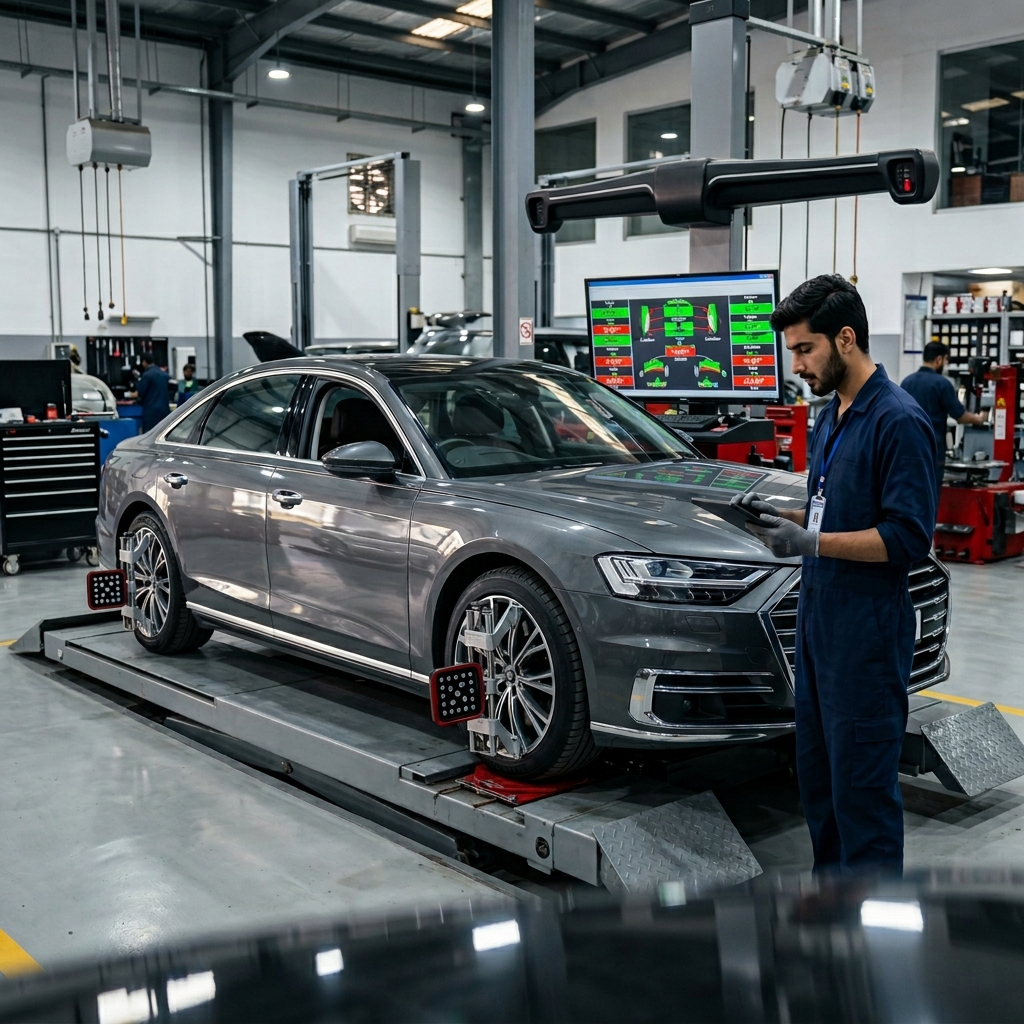
Step 3: 3D Computerized Alignment Check
We mount laser-guided targets on all four wheels and roll the vehicle onto our 3D alignment rack. A series of high-resolution digital cameras read the targets to measure the camber, caster, and toe angles down to the hundredth of a degree, comparing the data against the exact factory specs for your vehicle's make and model year.
5. The Spectrum of Suspension Services We Execute
Our service center is equipped with heavy-duty hydraulic presses, pullers, and alignment bays to service the following systems:
Shock Absorber and Strut Assembly Replacement
When shocks or struts leak or fail the bounce test, we replace them. Crucially, we always replace shocks and struts in pairs (both front or both rear) to maintain balanced damping across the axle. We also inspect and replace worn upper strut mount bearings and bump stops during assembly.
Control Arm & Bushing Pressing
Many workshops force customers to buy an entire control arm assembly when only the rubber bushing is torn. We house heavy-duty hydraulic shop presses that allow us to press out the old, worn rubber bushing and press in a new OEM replacement bushing, saving you significant money while maintaining original structural integrity.
Ball Joint & Tie-Rod End Replacement
Worn ball joints and loose outer tie rod ends are safety critical. We extract the worn joints using specialized pullers to avoid damaging the surrounding steering knuckle, installing new greasable or sealed joints torque-tightened to exact factory specifications.
Air Suspension Repairs and Conversions
Many luxury vehicles in Dubai (such as Land Rover, Mercedes-Benz, BMW, and Porsche) are equipped with complex pneumatic air suspension systems. When these systems fail, the car will sag completely to the bump stops. We diagnose and repair leaking air struts, faulty ride height sensors, leaking valve blocks, and burnt air compressors. We also offer reliable coil-spring conversion kits for select vehicles as a permanent, cost-effective alternative to continuous air suspension repairs.
6. The Economics of Steering & Suspension Repair
Maintaining your suspension is not just about a smooth ride; it's a critical financial decision. Suspension alignment and tire wear are directly linked. If your alignment is misaligned by just a few millimeters, it can completely ruin a brand-new set of expensive performance tyres in less than 5,000 kilometers. The cost of a 3D wheel alignment is a tiny fraction of the cost of replacing premium tyres.
Furthermore, suspension components act as a shield for the rest of your vehicle. When your shock absorbers are worn out, they fail to damp road vibrations. These high-frequency vibrations travel directly into the wheel bearings, steering rack, chassis, and interior cabin dashboard, causing premature wear to other expensive components. By investing in timely suspension bushing and shock replacements, you prevent a cascading effect of damage across your entire vehicle.
7. Dubai Survival Guide: Speed Bumps, Sand, and Heat
Dubai's environment places specific stresses on suspension systems. The factors that degrade suspension components in the UAE include:
1. Intense Dry Heat and Ozone
Underneath your car, temperatures can exceed 70°C due to road radiation and engine heat. This heat causes the rubber in suspension bushings, steering rack boots, and ball joint covers to dry out, lose elasticity, and crack. Once cracked, water and abrasive sand enter the joint, leading to failure.
2. Silica Sand Contamination
Fine desert sand is incredibly abrasive. It acts like liquid sandpaper, finding its way onto the chrome shafts of your shock absorbers. As the shock compresses, the sand particles wear out the internal hydraulic oil seals, causing the shock fluid to leak out.
3. High Speed Bumps (Sleeping Policemen)
Residential areas in Dubai (such as Jumeirah, Arabian Ranches, and Al Barsha) utilize numerous speed breakers. Traversing these speed bumps at speed places high-impact shear stresses on your control arms, sway bar links, and shock absorbers, leading to premature mechanical failure.
8. Frequently Asked Questions (FAQs)
How long do shock absorbers typically last in Dubai?
While typical shocks can last up to 100,000 kilometers in mild climates, the extreme heat and abrasive sand in the UAE mean that shocks should be closely inspected from 60,000 kilometers onwards. Most shocks in Dubai show signs of degradation around 70,000 to 80,000 kilometers.
What is the difference between a wheel alignment and wheel balancing?
Wheel balancing corrects weight distribution imbalances within the tire/wheel assembly, preventing vibration in the steering wheel at high speeds. Wheel alignment adjusts the mechanical angles of the suspension components to ensure the wheels roll straight and parallel, preventing pulling and uneven tread wear.
Can I drive my car with a leaking shock absorber?
You can physically drive the car, but it is not safe. A leaking shock has lost its hydraulic fluid, meaning it can no longer damp wheel oscillations. The wheel will bounce excessively, increasing your braking distance, accelerating tyre wear, and reducing handling stability in emergency maneuvers.
Why does my car squeak when I go over speed bumps?
This is usually caused by dry-rotted or cracked rubber control arm bushings or stabilizer bar bushings. As the suspension moves, the metal pivots grind against the dry rubber, creating a squeaking or creaking noise. Lubricating them is a temporary fix; replacement is the permanent cure.
What happens if a ball joint fails while driving?
If a worn ball joint completely fails (snaps) while driving, the steering knuckle will disconnect from the control arm. This causes the wheel to fold outward, causing a total loss of steering control and severe damage to the fender, axle, and brake lines. Worn ball joints must be replaced immediately.
How long does a 3D wheel alignment take?
A standard 3D wheel alignment takes between 30 to 45 minutes. If suspension adjustments require freeing up rusted adjustment bolts or modifying custom camber kits, it may take up to an hour.
9. The Final Word: Why Choose Our Suspension Services
At our facility, suspension repair is treated with the scientific precision it requires. We utilize high-resolution digital 3D alignment racks that are calibrated monthly to guarantee perfect alignments. Our technicians are trained to check the entire system thoroughly, diagnosing not just the symptom, but the underlying mechanical cause. We only use premium, OEM-quality shock absorbers and rubber components, ensuring that your vehicle retains its factory driving characteristics. We provide transparent, itemized quotes, photographic evidence of worn-out bushings, and a comprehensive guarantee on all labor and parts. Keep your drive smooth and secure. Contact us today to schedule a comprehensive suspension check.